Alternative Investment Funds in India are gaining significant traction as a preferred investment option for individuals seeking diversification across different risk levels, investment horizons, and financial objectives. Alongside traditional instruments such as equity, bonds, mutual funds, and fixed deposits, AIFs have emerged as a distinctive asset class offering access to non-conventional investment opportunities.
Among these options, Alternative Investment Funds (AIFs) stand out as a rapidly growing segment, pooling capital from investors to invest in alternative assets such as private equity, venture capital, hedge funds, and commodities. These funds are designed to deliver higher return potential while enabling investors to diversify beyond traditional market-linked instruments.
What are Alternative Investment Funds (AIFs) in India?
Alternative Investment Fund or AIF means any fund established or incorporated in India that is a privately pooled investment vehicle that collects funds from sophisticated investors, whether Indian or foreign, for investing it under a defined investment policy for the benefit of its investors. And AIFs do not include funds covered under SEBI Regulations 1996, SEBI Regulations 1999, and any other regulations of the board. Also, SEBI categorizes AIFs into 3 different categories.
AIFs differ from traditional assets, as on one side, AIFs rely on private equity, hedge funds, and venture capital for investments with higher risks and potential for higher returns, whereas mutual funds typically focus on stocks, bonds, and publicly traded options with low and steady returns. Also, AIFs generally target High Net Worth Individuals (HNIs) for investment, while mutual funds target investment from retail investors.
Types of AIF in India (Category I, II & III Explained)
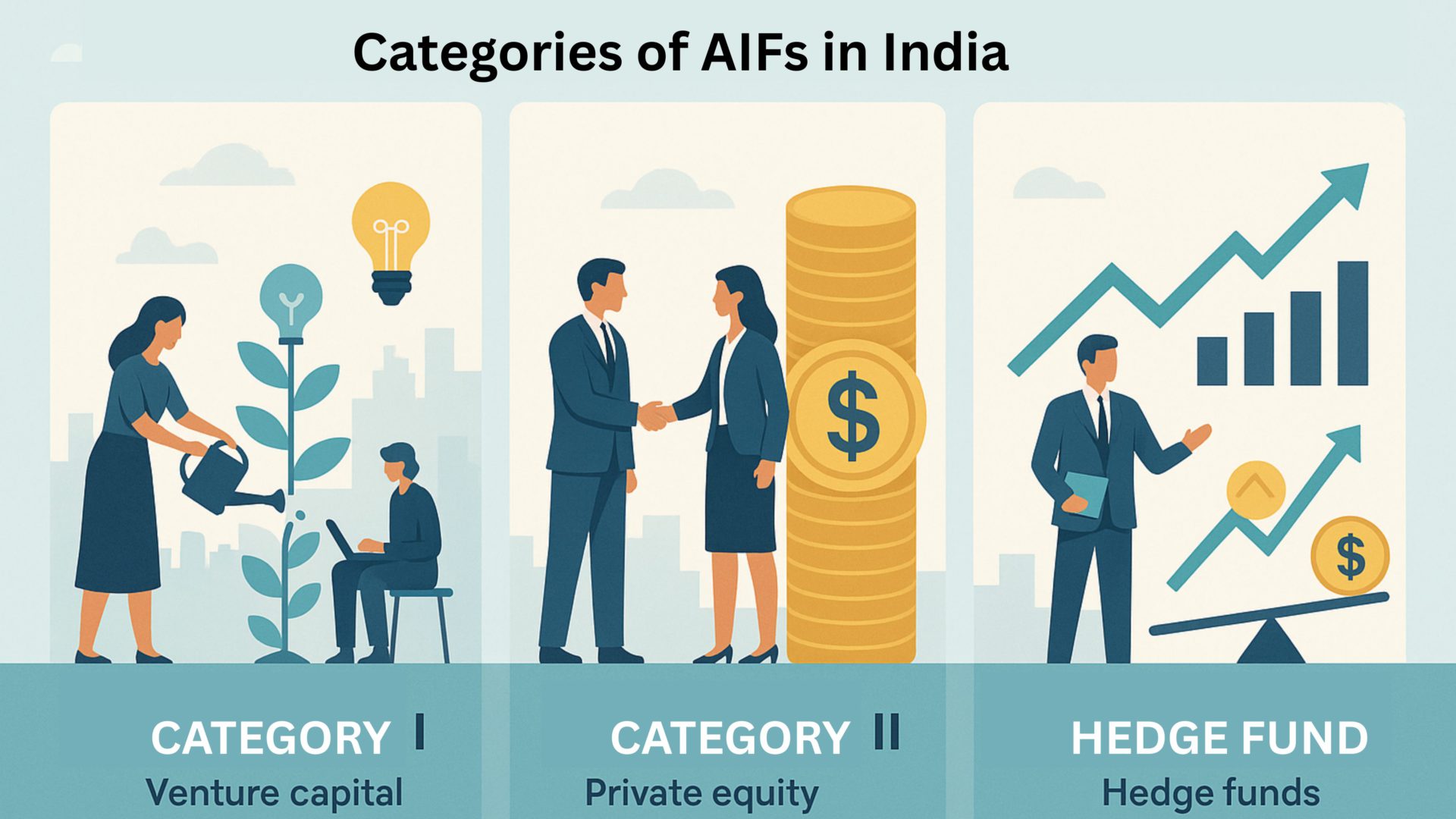
- Category I AIFs: These funds invest in start-ups, small businesses, or sectors that are considered socially or economically beneficial by the government. They generally carry lower risk and aim for long-term capital growth. These include venture capital, social venture, etc.
- Category II AIFs: These funds employ more complex investment strategies, such as private equity, debt, or structured products, and are intended for investors with a higher risk appetite seeking moderate returns.
- Category III AIFs: These funds focus on high-risk strategies like hedge funds, which may use leverage and short-selling to generate potentially higher returns.
Key Features of AIFs
AIFs can invest in a wide range of assets, including private equity, real estate, startups, and structured products. These funds are primarily designed for High Net Worth Individuals (HNIs) and institutional investors because of the higher risks and limited liquidity associated with the funds. AIFs often have long-term horizons (3-10 Years) with various lock-in periods. These funds are usually managed by professional fund managers who have expertise in alternative asset classes and facilitate maximizing higher returns.
Benefits of Investing in AIFs
-
Access to alternative asset classes: AIFs offer the opportunity to invest in asset classes unavailable in traditional portfolios, including venture capital, hedge funds, and real estate.
-
Diversification benefits: Understanding how AIFs work for wealth diversification is key. By investing in non-correlated assets, AIFs help lower overall portfolio risks, especially during periods of market volatility.
-
Opportunity for higher returns: AIFs provide access to niche markets such as startups and real estate development, which have the potential for higher returns compared to mainstream investments.
-
Expertise-driven portfolio management: Typically managed by experienced professionals, AIFs benefit from deep expertise that ensures effective decision-making and risk management, contributing to superior returns.
Risks and Challenges of AIF Investments
- Higher investment thresholds: AIFs typically require a higher minimum investment than conventional funds, which makes them less accessible for retail investors. This makes them a concentrated market with limited buyers, making them riskier if the funds encounter challenges.
- Illiquidity and lock-in periods: AIFs require the investors to commit the funds for a longer duration and with certain lock-in periods during which it becomes difficult to access funds, particularly in an illiquid market.
Regulatory compliance and transparency concerns: AIFs typically operate under regulations that differ from those of traditional funds, and these regulations can vary widely across jurisdictions. This can introduce compliance risks, particularly for investors who are not familiar with the specific regulatory frameworks in place.
AIF Tax in India: Rules, Benefits & Structure
In India, the tax treatment of Alternative Investment Funds (AIFs) differs based on the fund category. Category 1 and Category 2 AIFs benefit from favorable tax provisions, where the income is exempt at the fund level, and investors are taxed only on their gains. However, for Category 3 AIFs, income is taxed both at the fund level and again when distributed to investors as their share of the fund’s earnings.
Investments in certain Category I AIFs, such as those focused on social ventures or infrastructure, may be eligible for capital gains tax exemptions if specific conditions are met, such as a minimum holding period. In some cases, investors in Category II and III AIFs may be able to carry forward losses, especially if the fund’s income is considered business income, allowing for tax relief in future years.
Given the complexity of AIF taxation across different categories, many investors seek guidance from experienced Alternative investment fund advisors in India to ensure proper tax structuring, compliance alignment, and optimized post-tax returns.
Steps to Invest in an AIF
Future Trends in AIFs in India
The AIF industry is growing rapidly in India, driven by diversification in investment strategies. The regulatory landscape for AIFs for AIFs has been constantly evolving, with SEBI improving the framework through tax benefits and easier compliance processes. This has attracted institutions and high-net-worth individuals to diversify their portfolios into assets that were traditionally unavailable or hard to access. With India’s ecosystem flourishing, especially in the growing startup sector, private equity and venture capital are surging, and AIFs are capitalizing on these opportunities, offering high potential returns.
Final Perspective on AIF Investments:
Alternative Investment Funds (AIFs) provide a unique opportunity for high-net-worth individuals and institutional investors to diversify into unconventional assets like private equity and hedge funds. While offering higher returns and diversification, AIFs come with challenges such as high investment thresholds and limited liquidity, making them less accessible to retail investors. With India’s evolving financial landscape and growth in sectors like startups and infrastructure, AIFs present a promising avenue for long-term wealth creation for informed and risk-tolerant investors.
Achieve Your Financial Goals with Inspirigence’s AIF Expertise
Unlock the full potential of Alternative Investment Funds with our expert Alternative Fund Advisory services. Let our experienced advisors guide you in making informed and strategic investment decisions. Contact us today for a personalized consultation designed to align with your unique financial objectives!
About the Author
This article is prepared by financial professionals associated with Inspirigence Advisors, a leading advisory firm specializing in Alternative Investments, IPO advisory, and regulatory compliance in India. With extensive experience in working with High Net Worth Individuals (HNIs), institutional investors, and businesses, the team provides insights backed by market research, regulatory expertise, and practical investment strategies.
Editorial Review
This content has been reviewed and validated by financial experts at Inspirigence Advisors to ensure accuracy, regulatory alignment, and relevance for investors.
Inspirigence Advisors is a trusted financial consulting firm with proven experience in capital markets, IPO advisory, and alternative investments. Since 2017, the firm has been delivering expert services in fund accounting, regulatory compliance, and investment advisory for private equity firms, hedge funds, and growing businesses across India.
Frequently Asked Questions (FAQs)
1. What is the minimum investment required in an AIF in India?
Ans. As per SEBI regulations, the minimum investment in an Alternative Investment Fund (AIF) in India is generally ₹1 crore for investors, while employees or directors of the fund may invest a lower minimum amount (₹25 lakhs). Due to this higher entry threshold, AIFs are typically suitable for High Net Worth Individuals (HNIs) and institutional investors.
2. Are Alternative Investment Funds regulated in India?
Ans. Yes, AIFs in India are regulated by the Securities and Exchange Board of India (SEBI) under the SEBI (Alternative Investment Funds) Regulations, 2012. Funds must register with SEBI and comply with reporting, disclosure, and governance requirements to ensure investor protection and transparency.
3. How are AIF returns taxed in India?
Ans. Taxation depends on the category of the AIF. Category I and II AIFs generally enjoy pass-through status, where income is taxed at the investor level. Category III AIFs are taxed at the fund level. Since taxation structures can vary based on income classification, investors should carefully review fund documentation before investing.
4. Why should investors consult Alternative investment fund advisors in India before investing?
Ans. Investing in AIFs involves evaluating fund strategy, risk profile, tax implications, and regulatory compliance. Experienced Alternative investment fund advisors in India help investors assess these factors, conduct due diligence, and align AIF investments with long-term wealth objectives, reducing potential financial and compliance risks.
5. How do Alternative investment fund advisors in India support regulatory compliance?
Ans. Alternative investment fund advisors in India assist investors and fund managers in understanding SEBI regulations, reviewing fund documentation, assessing governance standards, and ensuring compliance with reporting requirements. Their expertise provides clarity and confidence when navigating complex regulatory frameworks.
6. How can Inspirigence Advisors help with AIF investments?
Ans. At Inspirigence Advisors, we offer structured Alternative Fund Advisory services, including regulatory review, tax planning support, fund evaluation, and governance assessment. Our advisory approach ensures that investors make informed decisions while maintaining compliance and optimizing long-term portfolio performance.